
Affiliate disclosure: As an Amazon Associate, we earn from qualifying purchases. We consider usefulness and total cost. How affiliate links work.
Quick answer: The OXO FurLifter garment brush is worth considering if you regularly buy sticky lint-roller refills for pet hair on clothes. A reusable brush can reduce that repeat expense if it replaces enough of your current routine. For occasional use, a tool you already own may be better value.
This is a research-based review, not a hands-on test. Sources checked on 17 November 2026. Amazon UK's page was inaccessible, so its current price, stock, seller and any discount remain unverified. We are not calling it a confirmed Amazon deal.
Check the garment model
This review covers OXO FurLifter Garment Brush model 12168800. OXO UK's page confirms the model and describes microbristles, a plastic body and a self-cleaning base without refills. Independent retailer data connects model 12168800 with ASIN B01DF316EC. That is identity evidence, not verification of a current UK offer.
The furniture brush is a different member of the range. Check model, quantity and whether the matching base is included when comparing listings. Do not assume a larger brush pictured in a search result is the same product at a better price. Some third-party listings have inconsistent pack quantities, so we have not treated those as reliable bundle information.
How to judge the design
The brush collects loose hair and lint, while the base clears the collected debris from the brush. The important practical question is whether this is easier for your normal clothing than peeling another sticky sheet. Published descriptions cannot answer that for a particular pet's hair or fabric weave, and we have not measured pickup performance.
Self-cleaning is not the same as maintenance-free. Debris still accumulates and needs emptying. Follow the supplied instructions rather than letting the base fill indefinitely. A brush that is already loaded with hair will not provide a useful comparison against a fresh adhesive roller.
Loose hair lying on a jacket is a different job from fibres caught deeply in a dense weave. Attached bobbles on a jumper are different again. This should not be bought as a general repair tool for worn knitwear or as a substitute for laundering stained clothes. Matching the tool to the problem avoids disappointment and unnecessary purchases.
Who is likely to get value?
The strongest case is a frequent lint-roller user who can keep the brush near the wardrobe and genuinely reduce refill purchases. Someone using only a few sheets a month has much less expense to avoid. For travel, the need to carry both brush and base may matter more than refill economics.
Consider where the hair comes from. If freshly cleaned clothes pick it up from a chair, changing where clothes are stored may prevent some of the work. If the main problem is an entire sofa, compare tools intended for upholstery. Buying a garment brush for a large furniture task may leave you with another product to purchase later.
Pros and cons
- Pro: no adhesive sheets to keep ordering.
- Pro: manual operation means no charging or batteries.
- Pro: the base offers a dedicated place to clear and store the brush.
- Con: both components need space and the base still needs attention.
- Con: results on your clothing and hair type have not been measured here.
- Con: it cannot be assumed to replace every roller, fabric-care or upholstery task.
Calculate the refill savings honestly
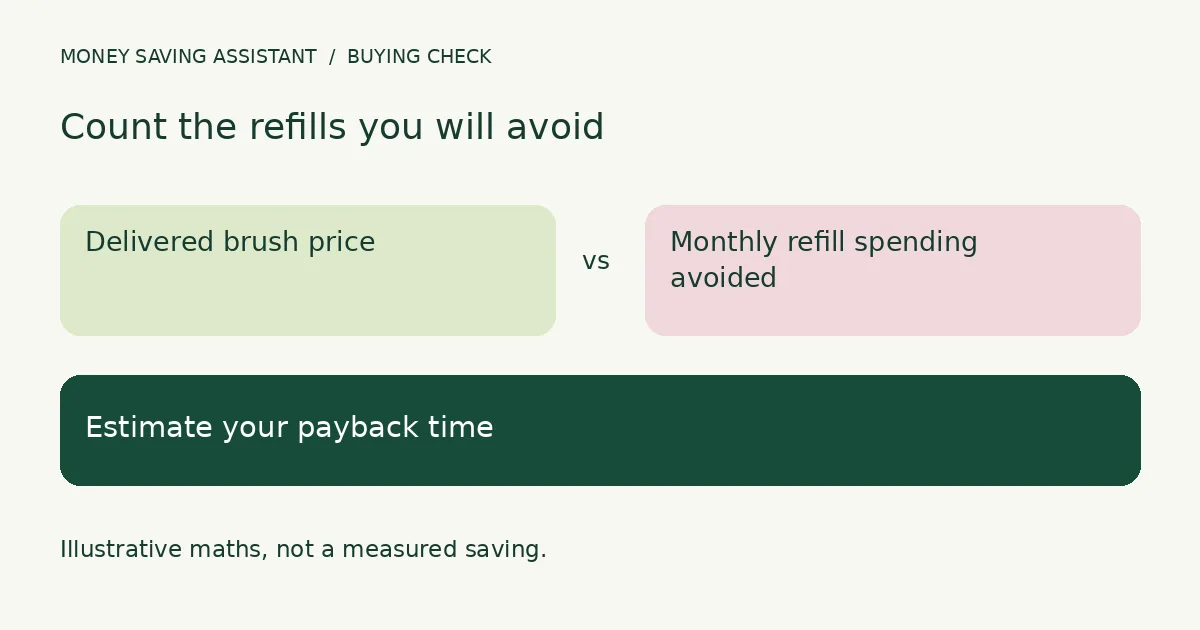
Add up what you actually spend on rollers or refill sheets during a normal month. Estimate the proportion that this brush could replace. Divide its delivered purchase price by that avoided monthly spending to estimate a simple break-even time.
For example, a hypothetical £18 brush replacing £3 of refills each month would recover its purchase cost in six months. If it replaced only £1 a month, the calculation becomes eighteen months. These are illustrative numbers, not this product's current price or a measured saving. If you keep buying the same quantity of refills, the claimed saving is zero.
Durability affects the calculation too. We have not tested how long the microbristles last. Refill-free does not mean everlasting, and buying two immediately doubles the initial cost. Try one for the intended task before equipping several rooms.
Alternatives to consider
A conventional reusable clothes brush may already do the job without needing a separate base. An adhesive roller can remain convenient for occasional touch-ups, especially if it is already in your cupboard. For larger textile areas, a suitable vacuum attachment offers a different approach, provided the fabric's care instructions permit it.
On delicate or loosely woven garments, check the care guidance and try an inconspicuous area gently. Stop if the tool catches or changes the surface. Protecting an expensive garment matters more than extracting every possible saving from a small cleaning purchase.
Value verdict
A sensible shortlist option for regular lint-roller users, because recurring costs can be compared directly. Occasional users should first consider the brush or roller they own. Buy for a routine expense you expect to reduce, not a promise that one tool will remove every hair. For another non-powered clothing-care purchase, see our HangOn drying-rack review.
Frequently asked questions
Does it require sticky refills?
No. OXO describes a reusable brush-and-base design without refill sheets.
Does it remove knitwear bobbles?
That is not its stated purpose. Attached pills and loose pet hair require different approaches.
Is it the furniture version?
No. This article covers garment model 12168800.
Is an Amazon discount verified?
No. Check the exact model, seller, quantity and delivered price on the current listing before buying.
Sources
- OXO UK: model, intended use and refill-free design
- Independent model-to-ASIN cross-check; not a UK price source
Check this product on Amazon UK
Product link, not a search link. Confirm the exact model, seller, pack contents and delivered price.
More ways to compare value
Use our Amazon savings guide to check whether buying more actually helps, or explore Home & DIY guides for practical household decisions.
Sources and checking notes
Research checked on 17 November 2026. Manufacturer descriptions support specifications; independent product records help distinguish models. Prices and availability can change.