
Affiliate disclosure: As an Amazon Associate, we earn from qualifying purchases. Our recommendations consider usefulness and total cost. How affiliate links work.
Quick answer: the Joseph Joseph Scoop Plus is useful if you want to lift pasta or vegetables from a pan while leaving the cooking water behind. It combines a scoop and a coarse strainer. It is not a complete replacement for a fine sieve or a large colander, and its broad head needs more storage space than a normal serving spoon.
This review is based on published specifications and practical buying analysis, not first-hand testing. Checked on 12 November 2026: Amazon’s product page was inaccessible, so live UK price, availability and seller could not be verified. This is an evergreen buying review, not a confirmed Amazon deal.
Exact model and verified details
The subject is the large black Scoop Plus, manufacturer model 10066. The product identifier B00LMCWL7A is associated with this model in published Amazon references; the current Amazon UK listing could not be inspected. Other colours have different manufacturer codes, so check both the colour and size before ordering.
Joseph Joseph specifies toughened nylon, suitability for non-stick cookware, heat resistance up to 200°C, dishwasher cleaning and dimensions of 7.5 × 34 × 13cm. Small hooks let the utensil rest on a pan to drain. The manufacturer expressly says to remove the cookware from its heat source before resting the utensil on it. Heat resistance is not permission to leave it against a hot hob or flame.
Why scoop instead of tipping the pan?
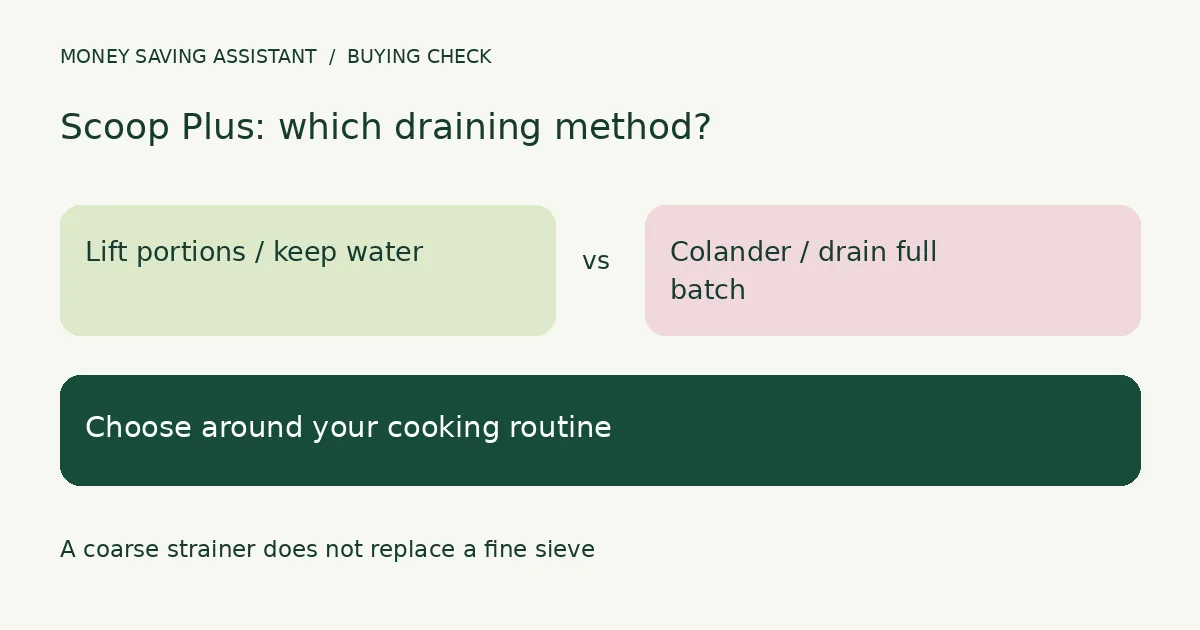
The most persuasive use is transferring cooked food into another pan or directly onto a plate. Scooping pasta into sauce leaves the cooking liquid available for adjustment. You can move one portion at a time and pause between scoops rather than handling the entire pan’s contents in one movement.
That is a workflow advantage, not a promise of faster cooking. A full family-sized pan may need several scoops. If you always want every drop drained and all the food transferred together, a conventional colander may be simpler. You also still need to empty the remaining water later; the tool changes when and how you handle the pan rather than making that job disappear.
Which foods suit it?
The broad head makes most sense for food pieces large enough to stay in a coarse strainer. Think pasta shapes and substantial vegetables rather than assuming it will retain every grain or tiny ingredient. For rice, fine grains or rinsing small seeds, keep a fine-mesh sieve. A scoop intended for cooked food is also a different purchase from a freestanding bowl in which you can rinse a whole batch under a tap.
Consider the pans you use. A broad head may be awkward in a narrow saucepan even when the overall length is comfortable. Before buying, compare its stated 13cm width with the usable opening of your smallest regular pan. Measure your utensil drawer too: a tool can be convenient at the hob and frustrating every time you try to put it away.
Pros and drawbacks
- Pros: separates food from liquid in smaller portions; leaves cooking water in the pan; combines lifting, draining and serving; no powered parts or consumables.
- Drawbacks: cannot replace a fine sieve; repeated scoops can be slower for large batches; substantial head takes drawer space; nylon requires attention to heat instructions.
Price and cost of ownership
The manufacturer’s black model page showed £14 on 12 November 2026, with standard home delivery of £4.95 below its free-delivery threshold. That is a direct-retailer reference, not an Amazon price or a historical discount comparison. Delivery and regional conditions can change, so check the final basket total.
For a single low-cost utensil, postage can change which shop offers better value. Do not add unrelated items merely to reach free delivery: saving a delivery fee by spending substantially more is only sensible when those items were already needed. Equally, a small price reduction does not justify a tool that duplicates a slotted spoon you already find adequate.
There are no refill costs. Ownership costs are mainly purchase, cleaning and eventual replacement if damaged. Check the head for damage and follow its care instructions; do not treat any plastic utensil as permanently heat-proof. We have not measured durability or established a lifespan.
Alternatives and value verdict
A slotted spoon you already own is the cheapest alternative for occasional small portions. A conventional colander suits draining a full batch. A fine-mesh sieve suits smaller foods, while a suitable metal spider strainer may appeal if nylon is not your preferred material; assess cookware compatibility separately.
Value verdict: buy it for a repeated pan-to-pan or pan-to-plate task, especially if retaining cooking liquid is useful. Do not buy it expecting one utensil to replace every strainer. Its strongest case is convenience during regular cooking, not a measurable reduction in household bills.
Frequently asked questions
Can it replace my pasta colander?
For portion-by-portion transfers, potentially. Keep a colander if you often drain whole batches or need a freestanding vessel for rinsing.
Can it stay on the pan while cooking?
The manufacturer says to remove cookware from the heat source before resting the utensil on top. Follow that instruction even though the material has a stated heat-resistance limit.
Is this the black model?
Yes: model 10066 is black. Confirm the seller’s selected variation and dimensions; the live UK listing was not accessible for this review.
Check this product on Amazon UK
Product link, not a search link. Check the model, pack contents, seller and delivered price before ordering.
More ways to compare value
Read our guide to judging Amazon savings before buying extras, and explore Home & DIY guides for practical household choices.
Sources and checking notes
Research checked on 12 November 2026. Manufacturer descriptions support specifications; retailer sources help distinguish the exact model. Availability and offers can change.